7 mins read

RED III Explained: EU Renewable Energy Directive and Organisational Impact
With the climate crisis intensifying and energy security taking centre stage, the European Union introduced RED III: a strengthened directive (from previously released RED II) designed to accelerate renewable energy deployment across all sectors. This regulation affects policymakers, utilities, businesses, industries, municipalities, and anyone involved in energy operations across the EU.
RED III marks a regulatory shift. It raises expectations for how energy is sourced, tracked, and documented across transport, industry, buildings, and heating and cooling. Whether supplying fuel, managing infrastructure, or aligning with emissions targets, RED III redefines the operational environment.
In the following sections, we’ll clarify what RED III entails, how it builds upon RED II, and what organisations need to understand to align with its provisions.

What is RED III?
RED III stands for the Renewable Energy Directive III, the European Union's latest legislation to promote the use of renewable energy across all sectors – electricity, heating and cooling, transport, and industry. Adopted in October 2023, RED III updates and strengthens the previous directive (RED II) to align with the EU's broader climate goals under the "Fit for 55" package.
RED III sets a binding EU-wide target: at least 42.5% of the EU's energy consumption must come from renewable sources by 2030, with an additional indicative goal of reaching 45%. This ambitious target demands rapid expansion of solar, wind, bioenergy, green hydrogen, and other sustainable technologies.
The directive goes beyond setting a headline target. It establishes sector-specific obligations, including minimum annual increases in renewable use for industry and heating, mandates for renewable fuel content in transport, and targets for renewable hydrogen. It also includes rules to simplify permitting procedures and increase data reporting and traceability for renewable energy use.
For businesses, RED III serves as a strategic framework that influences fuel procurement, energy sourcing, operational planning, and investment decisions across supply chains.
Category | RED II (2018) | RED III (2023) |
Overall Renewables Target | 32% (EU-wide, non-binding per sector). | 42.5% (binding EU-wide), with 45% indicative target, in line with the REPowerEU Plan. |
Transport Sector | 14% renewable energy in transport (target by 2030). | 29% renewable energy or 14.5% GHG intensity cut; 5.5% advanced fuels sub-target. |
Industry | No specific annual growth target. | Indicative +1.6 percentage points/year increase in renewables use. |
Green Hydrogen in Industry | No mandate. | 42% of industrial hydrogen must be renewable by 2030. |
Heating & Cooling | Indicative increases; no binding trajectory. | Binding +0.8% (2021-2025) and +1.1% (2026-2030) annual increases. |
Permitting Rules | General national-level provisions. | Fast-track permitting, especially in "acceleration areas" for renewables. |
Data Reporting & Compliance | Member State reporting to Commission. | Enhanced monitoring, credit systems, sustainability traceability requirements. |
Buildings | National plans encouraged renewable use. | Indicative national targets for renewables in buildings by 2030. |
Chain of Custody / Traceability | Limited recognition of chain of custody systems. | Emphasis on mass balance and robust chain of custody systems for compliance. |
RED III creates a more detailed compliance landscape and stronger opportunities for those that prioritise renewables, integrated data systems, and responsible supply chain practices.

It also reinforces the use of mass balance systems and chain of custody frameworks to trace the sustainability and origin of renewable fuels and feedstocks. Organisations are expected to verify and document how renewable content moves through their supply chains, making these systems essential for alignment with RED III obligations.


Sector-Specific Targets and Measures
Transport
Component | Requirement |
Renewable energy share in transport | Member States can choose to meet either a 29% renewable energy share in the transport sector or a 14.5% reduction in the greenhouse gas intensity of transport fuels by 2030, compared to 2010 levels. |
Crop-based biofuels cap | Capped at energy share reached in 2020, max 7% of transport energy. |
Advanced fuels (biofuels + RFNBOs) | Minimum 1% by 2025, rising to 5.5% by 2030. |
Minimum share of RFNBOs | At least 1 percentage point of the 5.5% advanced fuel target by 2030. |
EV charging incentive | Credit system for suppliers of renewable electricity for EVs. |
Optional national sub-targets | Encouraged for advanced biofuels and renewable hydrogen. |
Maritime fuel | 1.2% RFNBO share in marine fuels by 2030 (binding). |
Aviation fuel | SAF blending: 2% by 2025, up to 70% by 2050 (under separate ReFuelEU rules). |
What it means:
Fuel suppliers must meet stricter blending mandates for renewables, with an emphasis on waste-derived biofuels and RFNBOs.
Member States must implement a system for credit trading to encourage renewable electricity use in transport.
Maritime fuel RFNBO targets are binding; aviation fuel blending targets are set under ReFuelEU Aviation regulation.
Industry
Component | Requirement |
Annual renewables growth | Indicative +1.6 percentage points/year (2021–2030). |
Renewable hydrogen in industrial use | At least 42% by 2030; 60% by 2035. |
Use of industrial waste heat | Can be counted with a bonus of up to 0.4 percentage points. |
Green product labelling | Voluntary labelling for products made using renewable energy or hydrogen. |
What it means:
Member States must promote electrification or the shift to renewable fuels in industrial processes.
The renewable hydrogen mandate applies to hydrogen consumed in industry, requiring traceability and compliance documentation.
Green product labels can be applied by manufacturers using certified renewable inputs.
Heating and Cooling
Component | Requirement |
Annual growth in renewable share | +0.8% (2021–2025), +1.1% (2026–2030), based on 2020 baseline. |
Eligible contributions | Waste heat and renewable electricity (including heat pumps). |
Policy measures required | At least two measures, such as heat networks, solar thermal, or subsidies. |
Consumer-facing provisions | Energy labels, one-stop shops, simplified permitting for heat pumps. |
What it means:
Member States are required to implement binding growth in renewable heating and cooling share.
National policies must support these targets with financial, regulatory, and informational tools.
Use of industrial waste heat and heat pumps can partially raise growth rates beyond minimums.
Buildings
Component | Requirement |
Indicative national building target | Guiding target for renewable share in buildings by 2030 (non-binding). |
Public buildings | Must include renewable systems under EU building rules. |
What it means:
Member States must define and report renewable targets for building energy use.
Public buildings serve as required early adopters of solar and renewable heating installations.
National building codes and renovation strategies must support these targets.
Power and District Heating
Component | Requirement |
Permitting | Accelerated approval in "renewables acceleration areas". |
PPAs (Power Purchase Agreements) | Facilitated to boost corporate renewable energy sourcing. |
EV grid integration | Charging networks must support integration with variable renewable power. |
District heating & cooling | Indicative +2.2% annual increase in renewables/waste heat (2021–2030). |
Third-party access | Networks >25MWth must enable access for external renewable heat producers. |
What it means:
National authorities must fast-track permitting for renewables in designated zones.
Utilities and large heat operators must open infrastructure to third-party renewable and waste heat suppliers.
Energy planning must align infrastructure upgrades with grid decarbonizsation and renewable uptake.
RED III Certification: What Qualifies
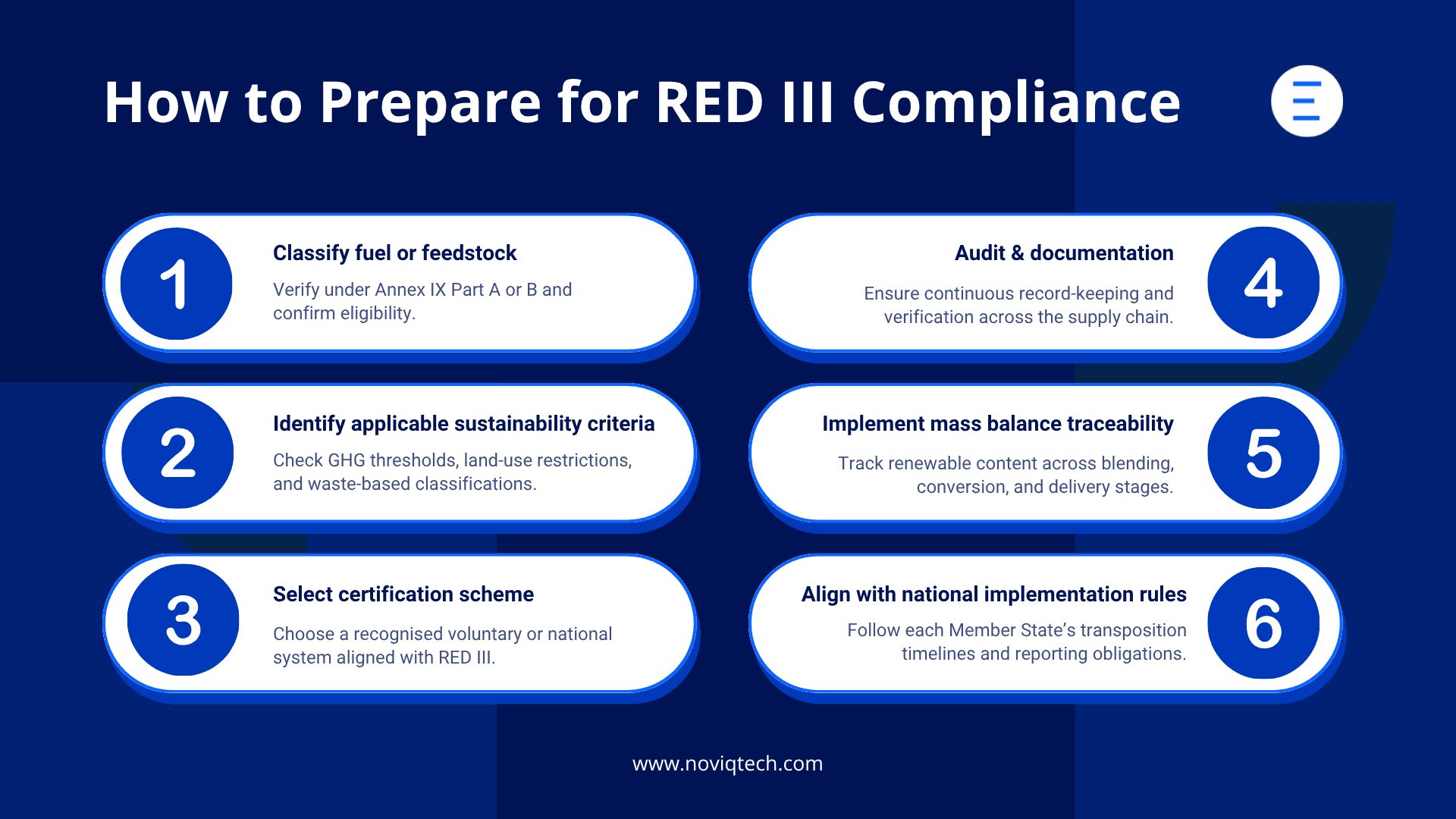
To demonstrate compliance with RED III, companies involved in producing, supplying, or using renewable energy must work with EU-recognised certification bodies. These schemes ensure that fuels and energy sources meet RED III sustainability and greenhouse gas savings criteria, as detailed in Annex V and VI of the directive.
Certification systems must be based on a chain of custody approach, most often mass balance, and include third-party audits, transparent documentation, and consistent reporting practices.
Only energy and fuels certified under an approved voluntary scheme or national system will be eligible to count toward RED III targets. A strong strategy includes structuring your certification and sustainability data using a digital traceability platform like Fuel Central, which integrates with any data source and supports compliance workflows.
Conclusion
RED III is a legal framework with clear deadlines, obligations, and technical thresholds. It affects energy sourcing, reporting systems, supplier relationships, and operational planning. The regulation requires businesses to act by securing certified renewable inputs, adapting procurement and tracking tools, and aligning with new fuel and energy standards.
Success under RED III depends on verified data. Organisations that build traceability and certification systems around reliable, connected information will minimise compliance risk, strengthen reporting credibility, and operate with greater certainty.
Need help preparing for RED III compliance? Contact us to explore how we can support your transition.
Primary Source: RED III Directive and Legal Text
Full Official Text of Directive (EU) 2023/2413 (RED III)
eur-lex.europa.eu/eli/dir/2023/2413/oj/eng
Specific RED III Provisions
42.5% EU Renewable Energy Target by 2030
Reference to Article 3 RED III: 42.5% renewables targetRenewable Fuels and Transport GHG Intensity Reduction
Article 25 RED III: Renewable fuels and 14.5% GHG intensity targetAdvanced Biofuels and RFNBOs in Transport – 5.5% Combined Target
Advanced fuels sub-target under Article 25(1)Heating and Cooling – Annual Renewable Increase Targets
Article 23 RED III: +0.8% and +1.1% annual increase requirementsRenewable Energy Use in Buildings
Member State obligations under Article 15aRenewable Electricity from the Grid – Accounting Method
Final consumption accounting rules under Article 22aMethodology for GHG Emission Savings
Article 7 RED III: GHG accounting rulesMass Balance Chain of Custody Requirements
Article 30 RED III: Mass balance system for traceabilityGaseous Renewable Fuels and Recycled Carbon Fuels
Annex V/VI and Article 29 on fuel definitions and eligibility

More Regulations