7 mins read

Understanding the Carbon Offsetting and Reduction Scheme for International Aviation (CORSIA) Scheme
Carbon Offsetting and Reduction Scheme for International Aviation (CORSIA) is a global program developed by the International Civil Aviation Organization (ICAO) as a part of a broader package to achieve its goal of carbon-neutral growth of the aviation sector from 2020 onwards.
Agreed in 2016 and launched in 2019, CORSIA is the first worldwide market-based climate scheme for any single industry sector. It requires airlines to monitor and report their CO₂ emissions on international routes and offset any increase above a set baseline level by funding equivalent carbon reductions (offsets) elsewhere or by using cleaner fuels.
How CORSIA Works and Its Goals
CORSIA is a market-based scheme, implemented in three phases: a voluntary pilot phase (2021-2023), a voluntary first phase (2024-2026) and a mandatory second phase with some exceptions (2027-2035). As of 2026, a total of 130 states are participants under the scheme.
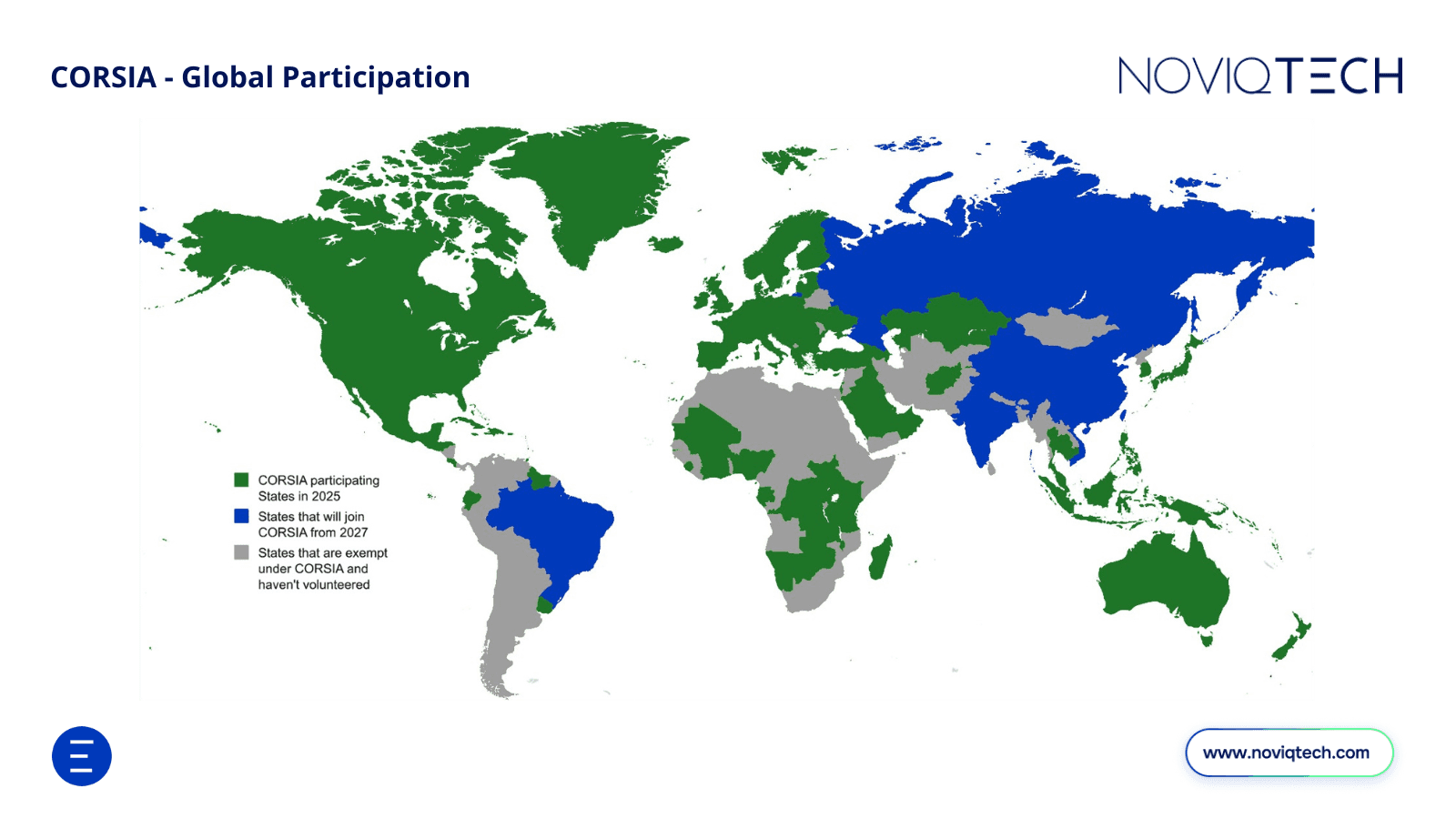
Source: IATA (2024), Adapted by NoviqTech (2026)
At a fundamental level, CORSIA requires aircraft operators to reduce or offset any emissions above a baseline, which is currently set at 85% of their 2019 emissions. Any emissions above this baseline are the CORSIA offsetting requirements and must be reduced by aircraft operators to stay compliant. There are two ways in which the operators can reduce their net emissions:
By retiring or cancelling CORSIA Eligible Emissions Units (EEU): Aircraft operators can address their offsetting requirements by retiring CORSIA EEUs, supplied by CORSIA-compliant carbon credit programs.
By purchasing CORSIA Eligible Fuels (CEF): Aircraft operators can reduce their offsetting requirements by purchasing CEF, that include CORSIA-compliant Sustainable Aviation Fuels (SAF) and Lower Carbon Aviation Fuels (LCAF). Typically, SAF is derived from a renewable or waste-based feedstock, and LCAF is derived from a fossil-based feedstock.
The strategy that an aircraft operator uses with regards to the above two options to address its offsetting requirements will depend on a variety of factors, such as cost considerations, fuel availability, etc.
CORSIA Eligible Emissions Units
CORSIA EEUs are another avenue through which aircraft operators can address their offsetting requirements through purchasing and retiring carbon offsets from CORSIA-compliant carbon credit programs. Each credit represents one tonne of verified CO₂ reduction or removal that airlines can purchase and retire to address offsetting obligations.
There are also additional requirements with regards to carbon projects, such as age/vintage of the credit, project eligibility, and the host country authorisation of the use of these credits for CORSIA compliance and prevention of double-counting under the Paris Agreement.
While the CORSIA framework permits airlines to address their offsetting obligations using Eligible Emissions Units (EEUs), an overreliance on these credits may present with a range of limitations. EEUs are based on offsetting mechanisms that often raise concerns around environmental integrity, additionality, and inconsistent standards, which can undermine confidence in their actual climate impact. As a result, they are increasingly viewed as a short-term compliance tool rather than a credible long-term decarbonisation strategy.
Example (illustrative): An airline with a 50 000 t CO₂ offset obligation can retire 50 000 CORSIA-eligible credits, say, from an eligible project under Gold Standard, to meet that requirement. Once cancelled for CORSIA, those units cannot be reused or claimed by any other entity.

CORSIA Eligible Fuels (CEF)
Under CORSIA, airlines can lower their offsetting obligations by using certified low-carbon fuels known as CORSIA Eligible Fuels (CEF):
Sustainable Aviation Fuel (SAF): Alternative jet fuels from renewable or waste-based sources that meet CORSIA sustainability and lifecycle requirements.
Lower Carbon Aviation Fuel: Certain fossil-based fuels that achieve a verified lifecycle CO₂ reduction relative to conventional jet fuel.
Eligibility Criteria for a fuel to be considered CEF:
Minimum lifecycle GHG reduction threshold: at least 10% versus conventional jet fuel, calculated across the full lifecycle, including emissions from land-use change (ILUC) where applicable.
Certification by an ICAO-approved Sustainability Certification Scheme (SCS): for example, RSB and ISCC. These schemes certify compliance to ICAO sustainability criteria, chain-of-custody management, internal management systems and lifecycle GHG intensity calculations.

Measurement, Reporting, and Verification (MRV) for CORSIA Compliance
In essence, operators looking to participate in the CORSIA Scheme need to comply with key requirements as follows:
GHG Emissions Intensity Calculations
Participating operators must calculate emissions intensity of CEFs in accordance with CORSIA’s methodology for lifecycle GHG values for either the default or actual values. Typically, newer generation fuels and feedstocks would benefit from using the actual values methodology as it allows for a more accurate GHG emissions reduction claim as compared to the default values. As these calculations are required for every batch of fuel, it is useful to establish internal systems to perform such calculations in an ongoing manner.
CORSIA Sustainability Criteria
Participating operators, depending on their scope of certification under the sustainability certification scheme, are required to comply with CORSIA Sustainability Criteria through gathering data and maintaining records that prove compliance. Additionally, certification schemes like RSB offer a more stringent ‘RSB CORSIA Certification’ that requires operators to additionally comply with RSB Principles and Criteria, as well as achieve GHG reductions that are greater than just the CORSIA requirements.
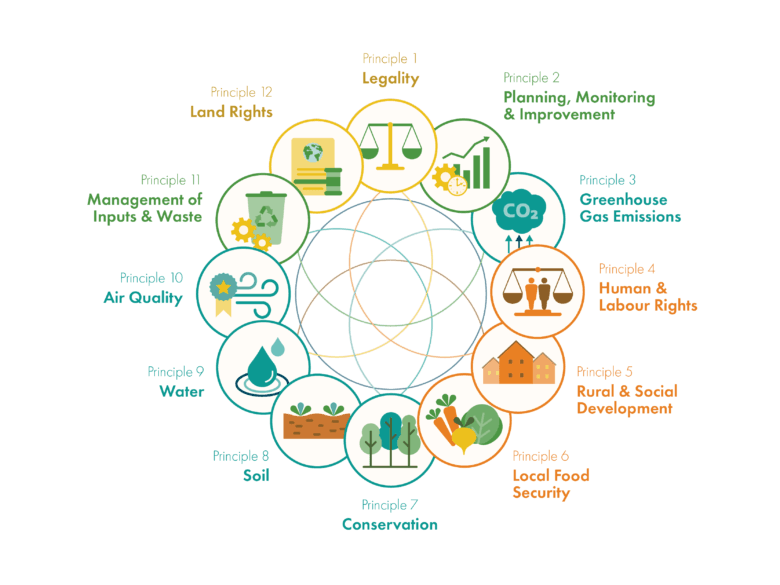
Source: The 12 RSB Principles and Criteria
Chain of Custody Management
The operators are required to maintain and update a robust chain of custody model, which are systems that track materials and their sustainability attributes through every step of a supply chain. For CORSIA compliance, operators are required to track both the physical fuel, as well as the associated sustainability attribute for every batch up to the blending point. As this is a supply chain certification scheme, every operator is required to transfer chain of custody and GHG intensity information using a valid Proof of Sustainability (PoS) or similar document.
Reporting and Verification
Certification of an operator under CORSIA by a Sustainability Certification Scheme (SCS) comes with ongoing reporting, verification and audit requirements that must be met to stay compliant. The SCS then uses the provided data to report to ICAO as per CORSIA Eligibility Framework and Requirements for Sustainability Certification Schemes.
Conclusion
CORSIA represents a landmark scheme that addresses aviation’s climate impact at a global level. It creates a framework where airlines take responsibility for growth in emissions by investing in emissions reductions, whether through market-based offsets or by adopting cleaner fuels.
Although there are challenges ahead in ensuring sufficient supply of high-quality offsets and sustainable fuels, the scheme provides an important near-term solution to curb aviation’s carbon footprint while longer-term technologies (like electric or hydrogen aircraft) are still in development.
Crucially, for participating operators, having internal management systems that can help stay compliant with CORSIA is key for growth and scalability. By offering an end-to-end traceability, GHG intensity tracking, and compliance reporting management, Fuel Central is helping operators processing and supplying CORSIA Eligible Fuels be more transparent and contribute towards a net-zero aviation future.

More Regulations