











Mass Balance Chain of Custody for Sustainable Fuels

Mass Balance Chain of Custody for Sustainable Fuels

Build audit-ready mass balance controls for RED III, ISCC EU, ReFuelEU, CORSIA, and Guarantee of Origin participation.

Build audit-ready mass balance controls for RED III, ISCC EU, ReFuelEU, CORSIA, and Guarantee of Origin participation.

Trusted by

Mass Balance Explained

Mass Balance Explained

What Mass Balance Requires from Organisations

What Mass Balance Requires from Organisations

What Mass Balance Requires from Organisations

What Mass Balance Requires from Organisations

Mass balance is a recognised chain-of-custody model that allows certified sustainable inputs to be mixed with conventional materials, provided the total sustainable output claimed never exceeds the certified input volume.


This model is formally recognised under ISO 22095 and required under multiple fuel and circular economy regulations.

Mass balance is a recognised chain-of-custody model that allows certified sustainable inputs to be mixed with conventional materials, provided the total sustainable output claimed never exceeds the certified input volume.


This model is formally recognised under ISO 22095 and required under multiple fuel and circular economy regulations.

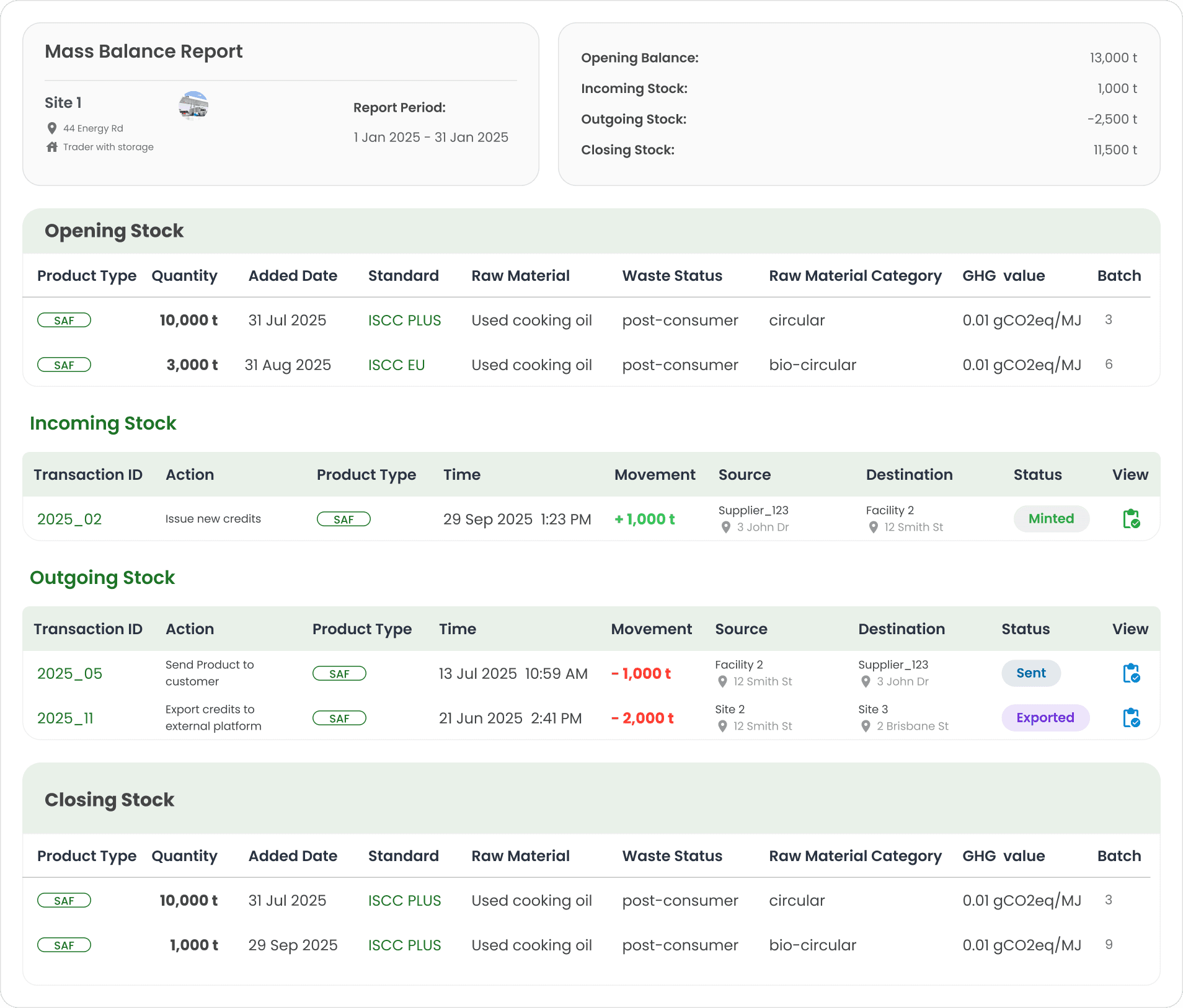
Input Output Ledger

• Record certified inputs by site
• Track outputs by batch or period
• Apply yield and loss factors

Claim Allocation Controls

Claim Allocation Controls

• Allocate sustainable share consistently
• Prevent over allocation and duplicates
• Retain proof with each shipment

Proud member of the Roundtable on Sustainable Biomaterials (RSB)

Proud member of the Roundtable on Sustainable Biomaterials (RSB)

Mass Balance Compliance Pathways

Mass Balance Eligible Compliance Pathways

Mass Balance Eligible Compliance Pathways

Mass Balance Eligible Compliance Pathways

Mass Balance Eligible Compliance Pathways

Mass balance underpins compliance where shared infrastructure makes physical tracking impractical.

Mass balance underpins compliance where shared infrastructure makes physical tracking impractical.

Renewable Fuels and SAF

Used across biofuels, SAF, renewable gas, and hydrogen pathways where blending, terminals, and networks mix product. Claims depend on verified sustainability data and conservative allocation.

Circular Feedstocks and Materials

Used for recycled and bio based inputs in chemicals, plastics, and manufacturing when co processed with conventional feedstocks. Claims depend on audited bookkeeping, not molecule sorting.

Where Mass Balance Breaks Down

Where Mass Balance Breaks Down

Where Mass Balance Breaks Down

Where Mass Balance Breaks Down

The model is straightforward. Execution fails when data, rules, and evidence stay fragmented.

Allocation Overruns

Certified output allocated beyond certified input across periods.

Conversion Factor Errors

Yields, losses, and blends misapplied across sites or batches.

Fragmented Evidence

Proof of sustainability files spread across inboxes and folders.

Weak Audit Replay

Hard to reconstruct claims from input to shipment under scrutiny.
Solution

Structured Infrastructure for Mass Balance Compliance

Structured Infrastructure for Mass Balance Compliance

Structured Infrastructure for Mass Balance Compliance

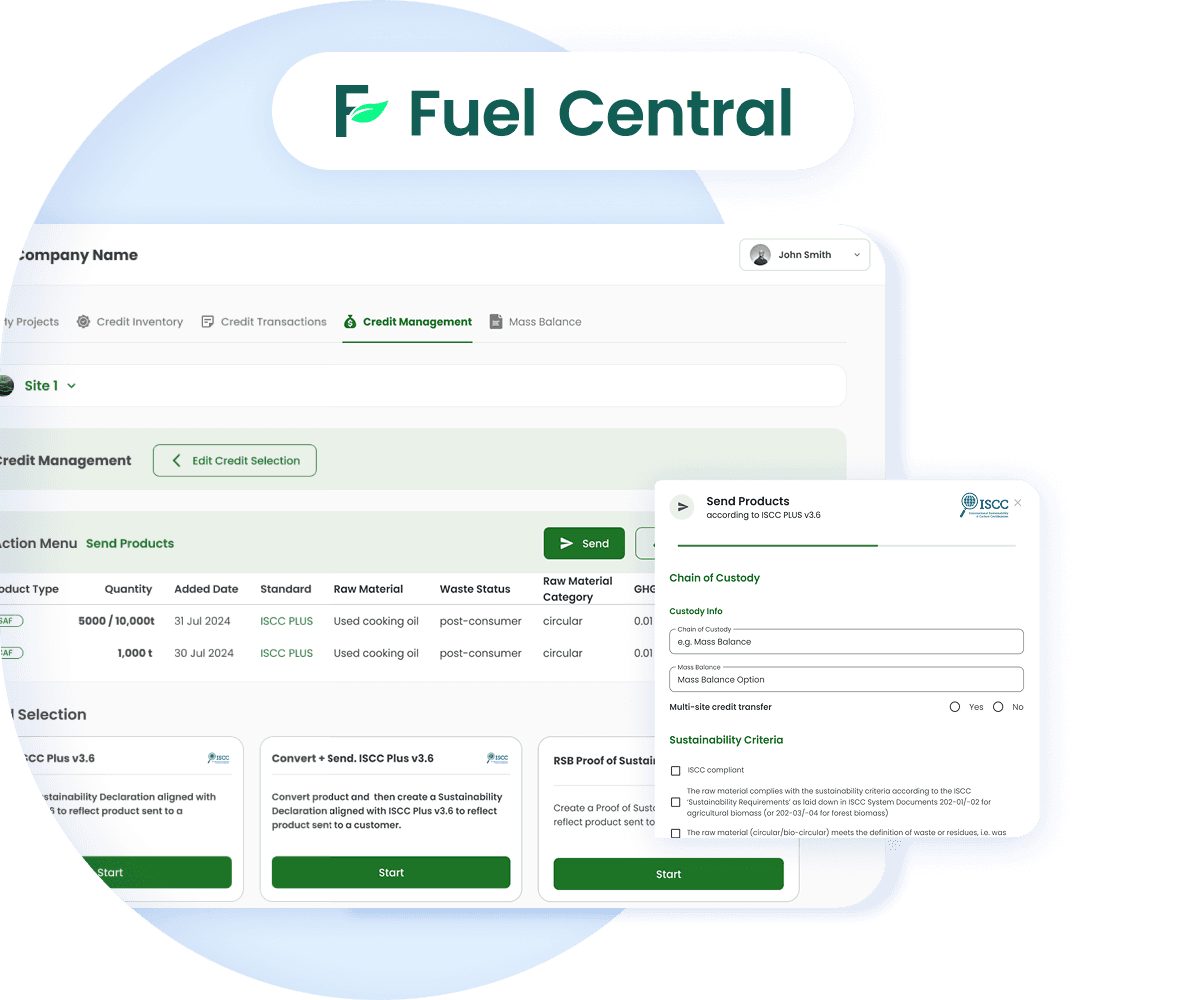
Fuel Central structures mass balance records and sustainability documentation across multi site supply chains. It supports consistent allocation logic and audit ready traceability.

Fuel Central structures mass balance records and sustainability documentation across multi site supply chains. It supports consistent allocation logic and audit ready traceability.

Mass Balance Accounting

Reconcile inputs and outputs across sites and periods using structured allocation logic and conservative loss handling.

Proof and Audit Trail

Link each claim to supporting documentation with timestamps, history, and relevant records for verification.

Assess Your Mass Balance Readiness

Assess Your Mass Balance Readiness

Assess Your Mass Balance Readiness

Before making sustainability claims, your organisation should be able to answer:

Before making sustainability claims, your organisation should be able to answer:

• Can we reconcile certified input to allocated output by site?
• Do we apply consistent yields, losses, and blending factors?
• Are proof of sustainability records linked to shipments?
• Can we replay a claim end to end for an audit window?
• Are roles and approvals defined for allocations and reporting?

Frequently Asked Questions

Frequently Asked Questions

What is mass balance in chain of custody terms?
Why do regulations and certification schemes use mass balance so often?
What mistakes create the biggest compliance risk with mass balance?
How does mass balance differ from segregation and book and claim?
What records are usually required for a mass balance audit?
Where should a company start when implementing mass balance?
What is the Book and Claim model and how does it work?

The Book and Claim model separates environmental attributes from physical product flow. A sustainable batch is certified, a certificate representing its attributes is issued, and that certificate can be transferred and retired independently of the physical product. This allows sustainability benefits to be claimed even when physical logistics are blended or distributed across regions.

How is blockchain used to verify Book and Claim transactions?
What data is required to implement a Book and Claim system?
What is the difference between mass balance and Book and Claim?
How does Book and Claim work in the context of SAF?

In Sustainable Aviation Fuel systems, a producer generates certified SAF and issues a certificate representing its emissions reduction and renewable content. The physical fuel may enter shared infrastructure, but the environmental attributes can be sold to an airline or corporate buyer who retires the certificate and claims the associated emissions reduction.

How does Book and Claim support Scope 3 emissions reporting?
Why is sustainability attribute certificate retirement important?
Should an organisation use mass balance or book and claim?
What is the Book and Claim model and how does it work?

The Book and Claim model separates environmental attributes from physical product flow. A sustainable batch is certified, a certificate representing its attributes is issued, and that certificate can be transferred and retired independently of the physical product. This allows sustainability benefits to be claimed even when physical logistics are blended or distributed across regions.

How is blockchain used to verify Book and Claim transactions?
What data is required to implement a Book and Claim system?
What is the difference between mass balance and Book and Claim?
How does Book and Claim work in the context of SAF?

In Sustainable Aviation Fuel systems, a producer generates certified SAF and issues a certificate representing its emissions reduction and renewable content. The physical fuel may enter shared infrastructure, but the environmental attributes can be sold to an airline or corporate buyer who retires the certificate and claims the associated emissions reduction.

How does Book and Claim support Scope 3 emissions reporting?
Why is sustainability attribute certificate retirement important?
Should an organisation use mass balance or book and claim?