











ReFuelEU Aviation Compliance Infrastructure

ReFuelEU Aviation Compliance Infrastructure

Prepare for SAF blending mandates, synthetic fuel sub-targets, refuelling rules, and Union Database reporting with structured traceability and audit-ready records.

Prepare for SAF blending mandates, synthetic fuel sub-targets, refuelling rules, and Union Database reporting with structured traceability and audit-ready records.

Trusted by

ReFuelEU Requirements

ReFuelEU Requirements

What ReFuelEU Aviation Requires

What ReFuelEU Aviation Requires

What ReFuelEU Aviation Requires

What ReFuelEU Aviation Requires

ReFuelEU Aviation establishes binding SAF blending targets across EU airports and introduces reporting, traceability, and refuelling obligations. It applies to fuel suppliers operating at Union airports and aircraft operators serving those airports.

ReFuelEU Aviation establishes binding SAF blending targets across EU airports and introduces reporting, traceability, and refuelling obligations. It applies to fuel suppliers operating at Union airports and aircraft operators serving those airports.

Fuel Supplier Obligations

• Mandatory SAF blending at each Union airport.
• Synthetic fuel sub-mandates from 2030 onward.
• Annual reporting to the Union Database (UDB).
• Full feedstock and lifecycle emissions disclosure.

Aircraft Operator Obligations

• 90% minimum fuel uplift (anti-tankering rule).
• Annual verified reporting to authorities and EASA.
• SAF claims under EU ETS or CORSIA.
• Declaration preventing double reporting.

Proud member of the Roundtable on Sustainable Biomaterials (RSB)

Proud member of the Roundtable on Sustainable Biomaterials (RSB)

Proud member of the Roundtable on Sustainable Biomaterials (RSB)

ReFuelEU Compliance Pathways

ReFuelEU Eligible Compliance Pathways

ReFuelEU Eligible Compliance Pathways

ReFuelEU Eligible Compliance Pathways

ReFuelEU Eligible Compliance Pathways

Operators and suppliers must align with blending mandates and reporting frameworks.

Operators and suppliers must align with blending mandates and reporting frameworks.

SAF Supply & Blending Compliance

Track SAF volumes by airport.
Verify feedstock eligibility under Annex IX.
Allocate synthetic fuel volumes for sub-mandate tracking.
Structure lifecycle emissions data per batch.

Reporting & GHG Scheme Alignment

Report into the Union Database (UDB).
Avoid double claiming under EU ETS and CORSIA.
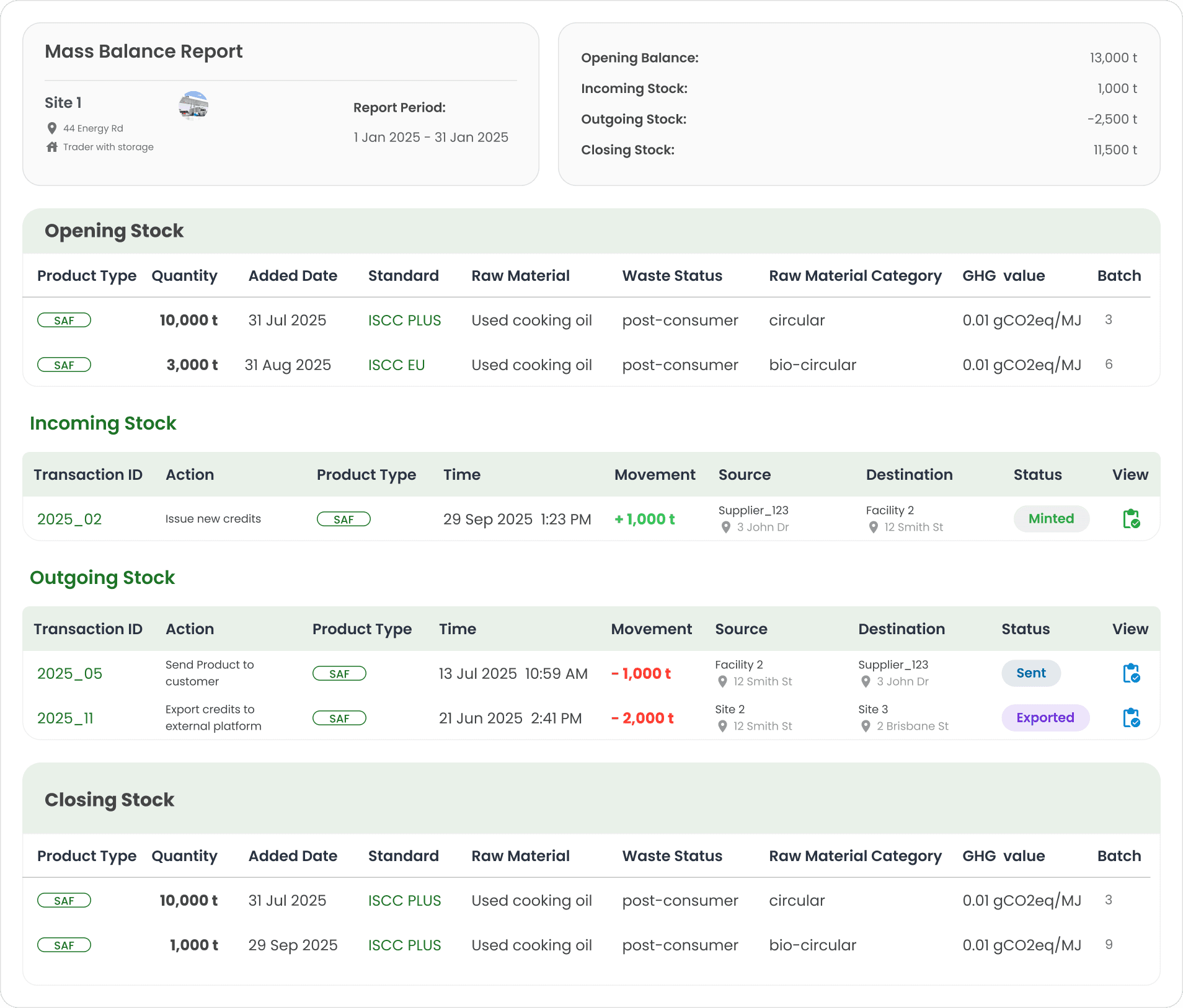
Maintain batch-level mass balance records.
Prepare verified annual submissions.

Where ReFuelEU Compliance Breaks Down

Where ReFuelEU Compliance Breaks Down

Where ReFuelEU Compliance Breaks Down

Where ReFuelEU Compliance Breaks Down

As SAF volumes scale, operational gaps create exposure.

Fragmented Sustainabilty Data

Feedstock origin, blend ratios, and lifecycle emissions stored across disconnected systems.

Fragmented Sustainabilty Data

Feedstock origin, blend ratios, and lifecycle emissions stored across disconnected systems.

Synthetic Sub-Mandate Gaps

RFNBO volumes not clearly tracked against the synthetic fuel requirement.

Union Database Misalignment

Internal records inconsistent with UDB reporting structures.

Double Claim Risk

SAF batches reported across multiple GHG schemes without allocation controls.

Solution

Structured Infrastructure for ReFuelEU Compliance

Structured Infrastructure for ReFuelEU Compliance

Structured Infrastructure for ReFuelEU Compliance

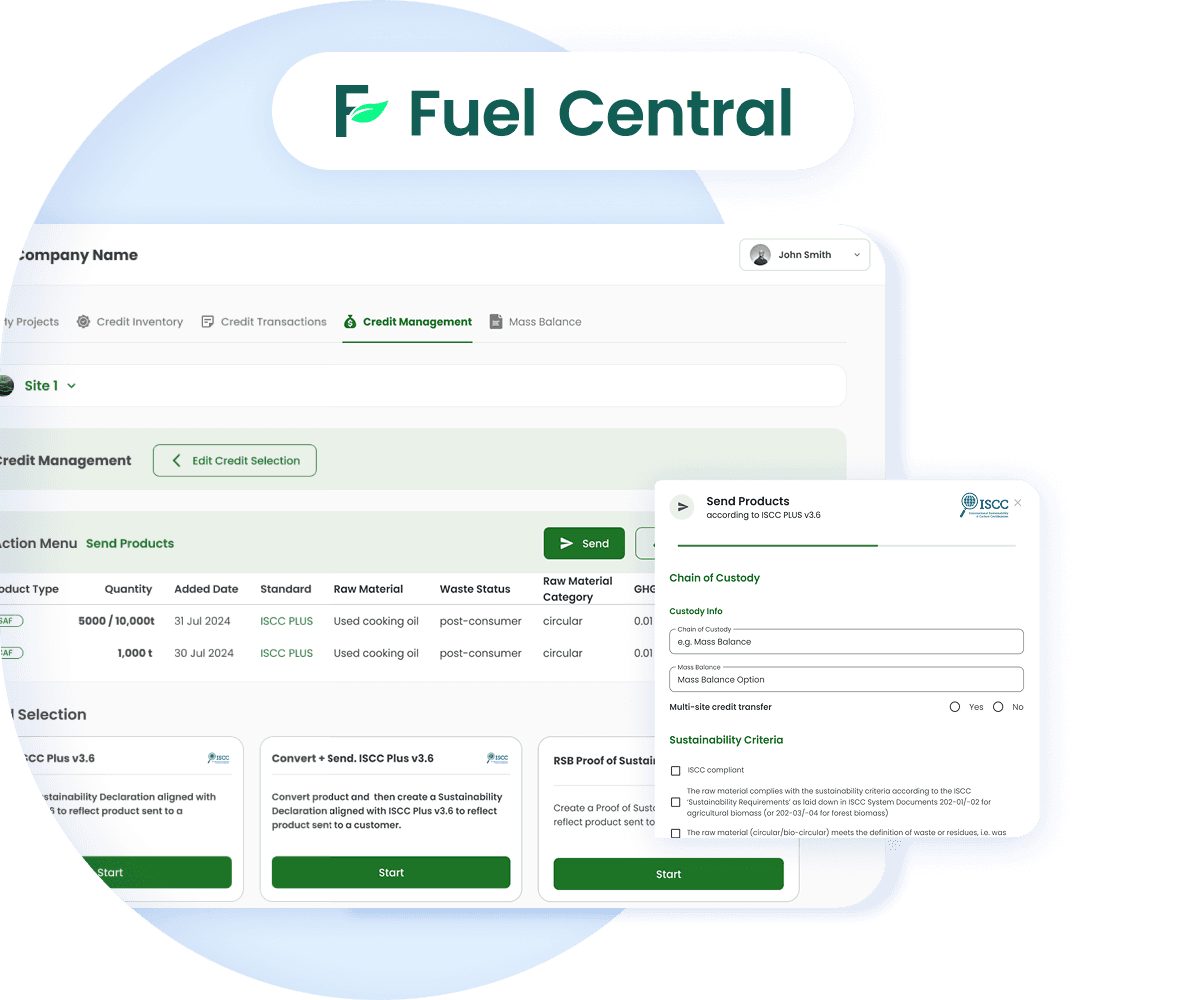
Fuel Central provides traceability architecture aligned with ReFuelEU reporting and blending obligations.

Fuel Central provides traceability architecture aligned with ReFuelEU reporting and blending obligations.

Data Management

• Track and record SAF documentation.
• Allocate synthetic fuel volumes.
• Structure Annex IX feedstock validation.
• Maintain auditable chain-of-custody records.

Reporting Control

• Align outputs to UDB requirements.
• Manage EU ETS and CORSIA allocation.
• Maintain lifecycle GHG calculation integrity.
• Support audit and verification readiness.
Assess Your ReFuelEU Readiness

Assess Your ReFuelEU Readiness

Assess Your ReFuelEU Readiness

Before submitting Union Database reports, your organisation should be able to answer:

• Can we isolate synthetic fuel volumes from total SAF supply?
• Are Annex IX feedstocks verified and documented?
• Are SAF batches linked to lifecycle emissions data?
• Can we prevent double reporting across EU ETS and CORSIA?
• Are refuelling volumes aligned with the 90% uplift rule?

Frequently Asked Questions

Frequently Asked Questions

Frequently Asked Questions

Who must comply with ReFuelEU Aviation?
What is the 90% uplift rule?
Can SAF be claimed under EU ETS and CORSIA?
What are the SAF blending targets under ReFuelEU?
What is the Union Database (UDB)?
What penalties apply for non-compliance?
What is the Book and Claim model and how does it work?

The Book and Claim model separates environmental attributes from physical product flow. A sustainable batch is certified, a certificate representing its attributes is issued, and that certificate can be transferred and retired independently of the physical product. This allows sustainability benefits to be claimed even when physical logistics are blended or distributed across regions.

How is blockchain used to verify Book and Claim transactions?
What data is required to implement a Book and Claim system?
What is the difference between mass balance and Book and Claim?
How does Book and Claim work in the context of SAF?

In Sustainable Aviation Fuel systems, a producer generates certified SAF and issues a certificate representing its emissions reduction and renewable content. The physical fuel may enter shared infrastructure, but the environmental attributes can be sold to an airline or corporate buyer who retires the certificate and claims the associated emissions reduction.

How does Book and Claim support Scope 3 emissions reporting?
Why is sustainability attribute certificate retirement important?
Should an organisation use mass balance or book and claim?
What is the Book and Claim model and how does it work?

The Book and Claim model separates environmental attributes from physical product flow. A sustainable batch is certified, a certificate representing its attributes is issued, and that certificate can be transferred and retired independently of the physical product. This allows sustainability benefits to be claimed even when physical logistics are blended or distributed across regions.

How is blockchain used to verify Book and Claim transactions?
What data is required to implement a Book and Claim system?
What is the difference between mass balance and Book and Claim?
How does Book and Claim work in the context of SAF?

In Sustainable Aviation Fuel systems, a producer generates certified SAF and issues a certificate representing its emissions reduction and renewable content. The physical fuel may enter shared infrastructure, but the environmental attributes can be sold to an airline or corporate buyer who retires the certificate and claims the associated emissions reduction.

How does Book and Claim support Scope 3 emissions reporting?
Why is sustainability attribute certificate retirement important?
Should an organisation use mass balance or book and claim?