5 mins read

Digital Twins for Sustainability and Operations
Companies in sectors such as SAF, biofuels, green hydrogen and resource recovery manage operational and sustainability data that often sits across equipment, logs and production systems. Carbon Central’s digital twin technology brings this information together in one model of the facility or process, creating a unified structure for monitoring, analysis and traceability across continuous industrial operations.
The model adapts to the way each site currently works. It can draw from integrations with sensors and control systems where they exist or update through manual entries, batch records and system exports. This ensures that facilities with different levels of digital maturity maintain a consistent view of emissions, production activity and chain of custody information while keeping their established workflows.
What a Digital Twin Represents
A digital twin is a virtual representation of physical operations, whether it is a biogas unit, a hydrogen electrolyser or a chemical recycling facility. By bringing together equipment data, production activity and emissions factors into one model, it gives teams a clear view of performance and a way to investigate changes without waiting for long reporting cycles. When integrations are active, the twin can incorporate live or near live data. When a facility relies on manual entries, the twin updates at the pace of those submissions while maintaining the same structured view.
This flexibility allows organisations to use the digital twin as a monitoring layer, a traceability tool or a preparation step toward future automation. It supports operations that are working toward continuous monitoring as well as those that need a unified system for periodic reporting, assurance and audit preparation.
Traceability and Data Integrity Across Operations
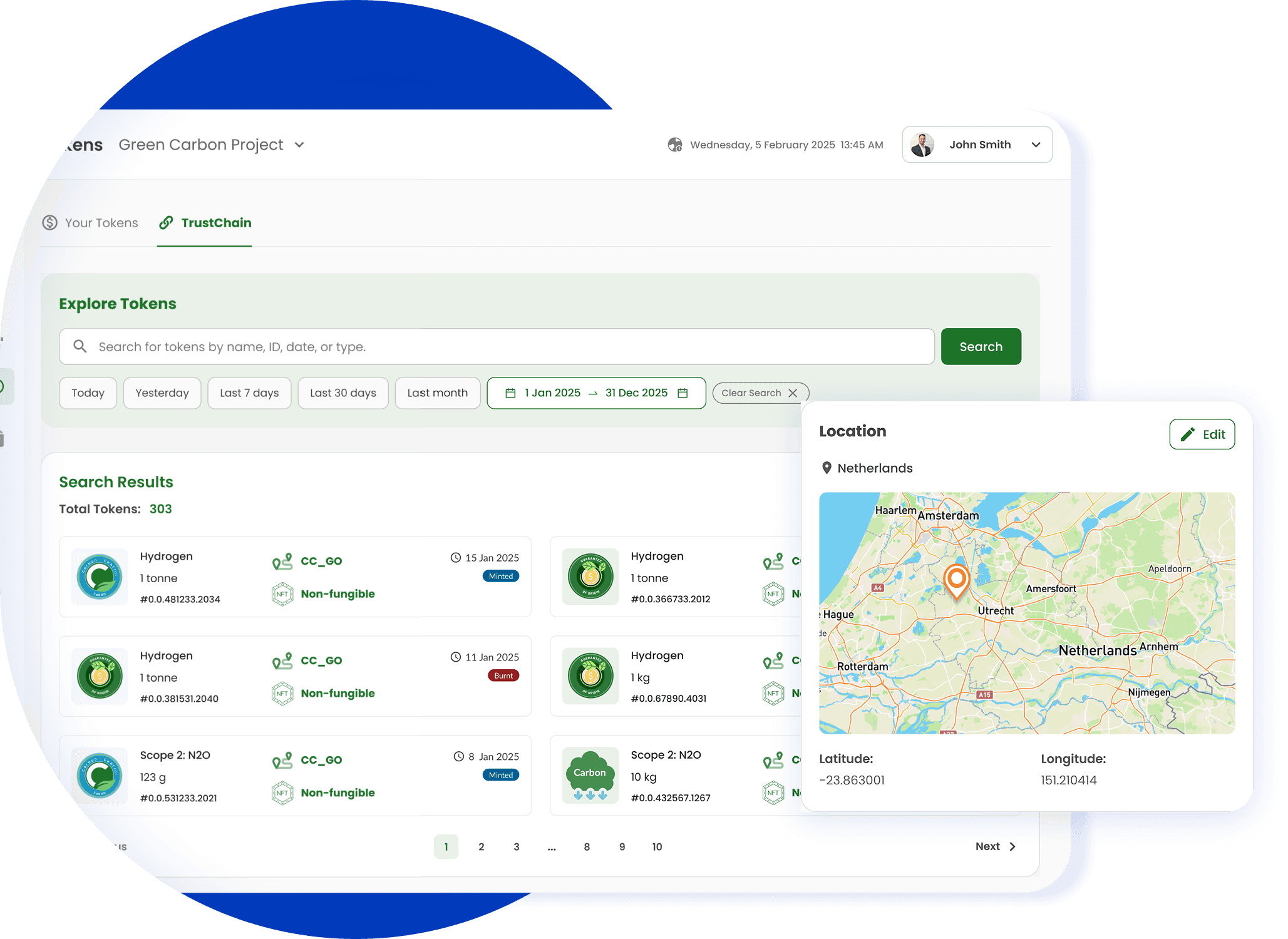
Digital twins can also strengthen traceability. In Carbon Central, for example, key data points are recorded on a secure ledger to maintain integrity across emissions, production activity and chain of custody documentation. This creates reliable evidence for claims related to carbon intensity, recycled content or renewable output. It also allows auditors, partners and regulators to review the same verifiable record without additional reconciliation work.
Verified outputs can be converted into digital certificates or tokens when required. These can represent Guarantees of Origin, batch level attributes or carbon credits, each carrying the data needed to demonstrate provenance, emissions and production metrics. A biogas facility, for example, can issue a certificate for each batch of renewable gas injected into the grid, with metadata that reflects source, quality and avoided emissions.
This approach supports operational teams, sustainability leads and compliance functions with a shared data structure. Whether the goal is automated monitoring, periodic reporting or preparation for regulatory requirements, digital twins create a consistent foundation that scales with the organisation.
In short, digital twins turn emissions and production information into a structured, traceable asset. Data becomes clearer, claims become verifiable and operational decisions become faster as organisations build capability at their preferred pace.
Predictive Maintenance and Operational Efficiency
Beyond tracking emissions, digital twins act as virtual testing grounds for your equipment and processes. They continuously compare sensor readings against expected performance models.
Over time, they learn the normal patterns of a facility – how a gasifier hums at peak output or how a solvent recycler behaves as throughput varies. When something begins to shift from expected patterns, the digital twin can detect the change early, often before it’s visible through routine monitoring.
This is the foundation of predictive maintenance. Consider a resource recovery plant where pumps circulate chemicals through a recycling system. If the pump’s energy draw creeps above its usual baseline or its output flow drops off slightly, the digital twin’s analytics might recognise an early sign of wear or fouling. It can alert engineers to schedule maintenance at the next convenient window.
The benefit is twofold: avoiding unplanned downtime (which in a continuous process could cause safety incidents or costly shutdowns) and avoiding unnecessary maintenance (servicing equipment only when data indicates it's needed).
According to Gartner research, leveraging digital twins can cut maintenance costs and boost overall productivity by reducing downtime. In an industry where uptime and efficiency directly impact output volumes and revenue, this improvement is significant.
Digital twins also drive operational efficiency by enabling scenario testing and optimisation. Because the twin mirrors the real process, engineers can simulate adjustments in a risk-free virtual environment. What if a waste-to-fuel plant could try a different process temperature or catalyst concentration in the twin to see how it affects yields and emissions? Instead of guesswork, the twin would show the likely outcome (e.g., a 5% increase in throughput but a slight rise in energy use). The team can then decide the best course of action based on data, implementing changes in the real plant that have been vetted in silico.
For companies in emerging green industries, these efficiencies can make the difference in scaling up profitably. It allows them to squeeze more output and reliability from the same infrastructure. Essentially, digital twins act as both a watchdog and a coach: preventing problems and constantly suggesting how to run a bit leaner, cleaner, and smarter.
Supply Chain Optimisation and Carbon Intensity Optimisation
Your operations don’t happen in isolation, they are part of broader supply chains involving feedstock inputs, transportation, and distribution of outputs. Here too, digital twins can play a transformative role by extending visibility across the supply chain and optimising each link for sustainability and efficiency.
Take a biodiesel producer as an example. They rely on feedstocks like used cooking oil or tallow collected from various sources, and they distribute their biodiesel to blending facilities or fueling stations. A digital twin of the production process can be expanded to model the supply chain: how feedstock moves from collection points to the refinery, how long it’s stored, how the refining process yields vary with feedstock quality, and how the final product is delivered.
By simulating this chain, the company might discover, for instance, that transporting feedstock in smaller batches more frequently reduces spoilage and emissions from decomposition, or that coordinating deliveries to minimise truck idling time at the plant significantly cuts fuel use.
For a resource recovery company dealing with hazardous waste or recyclable chemicals, supply chain efficiency is equally critical. Materials might come from multiple industrial clients and need segregation, processing, and then either disposal or sale as recycled product. A digital twin can track each batch from origin to final output. This ensures full visibility — if a certain batch of solvent has higher contamination, the twin can account for the extra steps or energy needed to treat it, and help plan the optimal processing order to avoid cross-contamination or process slowdowns.
The point is: optimising the supply chains with a digital twin often leads to reduced energy consumption and waste. Companies can model inventory levels to ensure resources (like a buffer tank of biogas or a stockpile of waste plastic) are at optimal levels – not so low that operations starve, but not so high that materials degrade or capital is tied up unnecessarily.
They can also forecast demand and supply fluctuations more accurately.
Another supply chain aspect is collaboration and data-sharing. Digital twins can serve as a common data platform between partners, for example, a green hydrogen producer and the utility that buys their hydrogen could share certain twin data. This could optimise the scheduling of hydrogen production to match renewable electricity availability, benefiting both sides. Such integration fosters a more resilient supply chain that responds dynamically to real conditions (like a sudden renewable energy surplus or a disruption in feedstock supply due to a weather event).
Ultimately, by optimising the entire value chain, organisations cut their own emissions and costs while providing a more reliable service to customers. They can guarantee delivery times, consistent quality, and transparent reporting of the product’s carbon footprint at each stage. In markets that increasingly value sustainability, that supply chain transparency becomes a competitive differentiator.
Compliance, Reporting and Digital Certificates for SAF, Biofuels and Recycling
Regulatory compliance is a fact of life across the green economy, and it’s only getting more demanding.
Whether you're producing SAF, refining biofuels, recycling industrial chemicals, or recovering materials, your business must document sustainability metrics like carbon intensity, emissions, and material traceability to qualify for incentives, meet certification standards, and access regulated or premium markets.
Doing this with spreadsheets and paper logs is time-consuming, error-prone, and out of step with the real-time nature of modern operations.
Digital twins simplify and strengthen compliance by automating data collection and reporting. Since the twin is already aggregating operational data, across emissions tracking, process monitoring, and supply chain flows, compiling a report becomes as easy as querying the platform. Instead of spending days gathering logs and reconciling multiple systems, teams can generate audit-ready reports in seconds, complete with timestamps, operating conditions, and verifiable data sources.
Because the data is traceable and securely stored, audits become far less painful. If a regulator, buyer, or certification body needs proof — say, total CO₂ per unit of product, or verification that a batch was sustainably produced — the digital twin can provide it instantly. Every data point is backed by secure traceability.
For example, Carbon Central can align with ISCC Plus, capturing all required data for sustainable product claims. A company recycling chemicals or producing SAF can easily show a full chain-of-custody, along with the carbon impact of each batch, simply by pulling up a tokenised certificate.
Beyond compliance, this builds business advantage.
With robust digital reporting, organisations can confidently pursue certifications like ISCC+, ISO 14001, or pathway approvals for sustainable fuels, unlocking access to new markets and customers that demand credible sustainability data.
And as regulations evolve, digital twins help you stay ready. If tomorrow’s rules require reporting water usage, Scope 3 emissions, or circularity data, you’re already capturing it in your operational twin.
In short, digital twins can reduce admin work, improve accuracy, and build the transparency that today’s investors, regulators, and customers increasingly expect.

Case Study: Digital Twin Traceability in Chemical Recycling
To illustrate these benefits, let's look at how Global Resource Recovery (GRR) is using Carbon Central’s digital twin platform to transform its operations. GRR is an Australian company that specialises in recycling industrial chemicals – things like spent glycol and amines from gas processing facilities. These substances, if not properly reclaimed, would either become hazardous waste or require energy-intensive disposal. GRR’s mission is to recover these materials, purify them, and send them back into industry for reuse, dramatically cutting waste and the need for new chemical production.
Prior to adopting digital twin technology, GRR faced a common challenge: proving the environmental value of its process in a rigorous way. Clients and regulators wanted evidence of how much waste was being diverted and what the carbon benefits were. GRR’s engineers, on the other hand, wanted better insight into their process efficiency – how much energy they were using per liter of chemical recycled, and where there was room to improve.
Implementation: GRR partnered with Carbon Central to deploy a digital twin of their Darwin recycling facility, integrating data from every stage of the operation. Flow meters and sensors on the input lines measure volumes of spent chemicals coming in, while quality sensors gauge contamination levels. Throughout the recycling sequence (which involves filtration, distillation, and chemical treatment steps), the twin monitors temperatures, pressures, energy consumption, and throughput rates. On the output side, it tracks the volume and purity of reclaimed glycol and amine products, as well as any by-products or waste.
Regular Insights: With this setup, GRR gained a live window into their process. If one batch of input chemical is particularly contaminated, the digital twin reflects how that impacts energy usage to clean it and flags if the process time is trending longer than usual. This allows operators to adjust parameters on the fly or prepare the system for a more intensive cleaning cycle after that batch. They’ve avoided situations where a hidden spike in impurities could have caused an unscheduled shutdown or a drop in product quality.
Tokenisation & Traceability: Each batch processed at GRR now generates a digital certificate of recycling – essentially a token containing all relevant data: origin of the waste, volume processed, date, and the resulting quantity and purity of recycled output. Carbon Central’s platform records these certificates on its Trust Chain ledger for an immutable record. This means GRR can provide any customer a guaranteed proof of provenance for the recycled chemicals they buy. A manufacturer purchasing reclaimed glycol can check a certificate and see that, for example, "1000 liters of 99% pure glycol were recovered on X date from Y source, saving Z amount of CO2 compared to virgin production."
This level of traceability has not only satisfied regulatory requirements but also boosted GRR’s appeal to environmentally conscious customers. It’s a differentiator that sets them apart from competitors who might simply provide a generic statement of recycling.
The GRR story showcases that digital twin technology delivers tangible results, moving beyond theory into a practical foundation for better business in green industries. From real-time control to building trust through data, the technology enabled GRR to scale up its impact.
The Digital Twin Advantage for Sustainability and Compliance
Digital twins bring sustainability data, operational performance and compliance into one consistent structure. Instead of treating emissions and production information as a periodic reporting task, organisations can turn it into an asset that supports decisions, assurance and long term planning.
Across sectors such as green fuels, SAF, recycling and resource recovery, teams use digital twins to reduce waste, improve utilisation and maintain traceable records of emissions and production activity. The data can update continuously where integrations exist or at defined intervals where operations still rely on manual entries, while keeping the same level of structure and traceability.
In an environment where regulators, investors and customers expect verifiable progress, NoviqTech's Carbon Central platform provides a digital twin and ledger based approach that supports credible claims, sustainability reporting and compliance. Emissions factors, production data and chain of custody records stay aligned in one system.
Teams that adopt digital twin models build a clearer view of their operations, strengthen trust with external stakeholders and position themselves for ESG linked markets and financing that rely on reliable data.
If you want to explore a digital twin for one facility or one product line, our team can work with you on a focused rollout that can scale as your data and infrastructure mature. You can book a strategy call here.

More Product & Tech