6 mins read
Sustainable Aviation Fuel in Japan: Strategy, Supply Challenges, and the Role of Book and Claim
Japan has committed to achieving net-zero greenhouse gas emissions by 2050. This national pledge places all sectors under pressure to decarbonise, including aviation, a sector of strategic importance for an island nation. As a country surrounded by sea with a growing tourism sector, Japan depends heavily on-air travel for international transport, making emissions reduction in this sector particularly important.
Rather than pursuing isolated initiatives, the government has fostered a coordinated strategy. Since April 2022, the Ministries of Economy (METI) and Transport (MLIT) have jointly led a Public-Private Council on SAF to integrate efforts across industry and agencies. This collaborative approach underlines Japan's view that decarbonising aviation requires enduring partnerships, rigorous planning, and alignment with broader climate commitments.
Japan’s Energy Dependence and Its Impact on SAF Supply
Japan's energy self-sufficiency is about 15%, meaning most fuel is imported. This reliance on imported energy extends to sustainable fuels.
Japan has limited domestic feedstock availability, from biomass to waste oils, to produce sustainable aviation fuel (SAF) in large volumes. Officials acknowledge that due to resource limitations, Japan will likely need to procure SAF feedstocks from abroad.
Alternative technologies face inherent limitations. Jet fuel's high energy density far surpasses that of batteries or liquid hydrogen, and no other fuels are currently ready to replace conventional jet fuel for commercial flights. In Japan's energy reality, sustainable drop-in liquid fuels emerge as the most feasible path to cut aviation emissions in the near term.

Scaling SAF Supply in Japan: Imports, Pilots, and Early Production
Japan's stated goal of reaching a 10% SAF share by 2030 translates into approximately 1.7 million kilolitres of alternative fuel per year. This concrete target anchors aviation decarbonisation in practical questions of supply, certification, and accounting.
In mid-2025, Japan supplied its first domestically produced SAF at Haneda Airport. The delivery marked an important milestone, but that domestic production is still nascent.
Japan’s aviation sector therefore relies on international supply chains to initiate and scale SAF use. For example, in a 2022 pilot project a Japanese firm imported SAF from Finland’s Neste (5,000 litres of neat SAF) to blend and test on flights.
Early projects reflect a broader assumption embedded in Japan’s SAF strategy: imported SAF will play a central role in meeting aviation decarbonisation targets.
This dynamic places international producers and fuel traders at the centre of Japan’s emerging SAF market. Suppliers that can provide certified feedstocks, documented production pathways, and verifiable emissions reductions will likely form the backbone of SAF supply to Japanese airlines in the coming decade.
Book and Claim in Aviation: How Japan Is Exploring Flexible SAF Accounting
Physical fuel supply introduces structural constraints. SAF production sites, blending facilities, and aircraft refuelling locations don't always coincide. Supplying physical SAF to every departure airport becomes increasingly complex as volumes grow and supply chains extend across borders.
This constraint affects not only airlines but also fuel producers, traders, and distributors participating in international SAF supply chains.
To manage this mismatch, Japanese operators are exploring book-and-claim systems, which separate the delivery of SAF into the fuel system from the allocation of its verified emissions reduction benefits. Under this model, an airline can support SAF production and claim its environmental value even when the fuel itself is supplied elsewhere.
Japan Airlines, for example, ran a pilot program between August 2024 and March 2025 exploring a SAF certificate trading platform designed to allocate lifecycle emissions reductions to corporate customers seeking to address Scope 3 aviation emissions.
To support flexible fuel sourcing across global supply chains, industry initiatives increasingly explore book-and-claim models that allocate SAF emissions reductions through verified sustainability certificates and records rather than through the physical movement of the fuel itself.
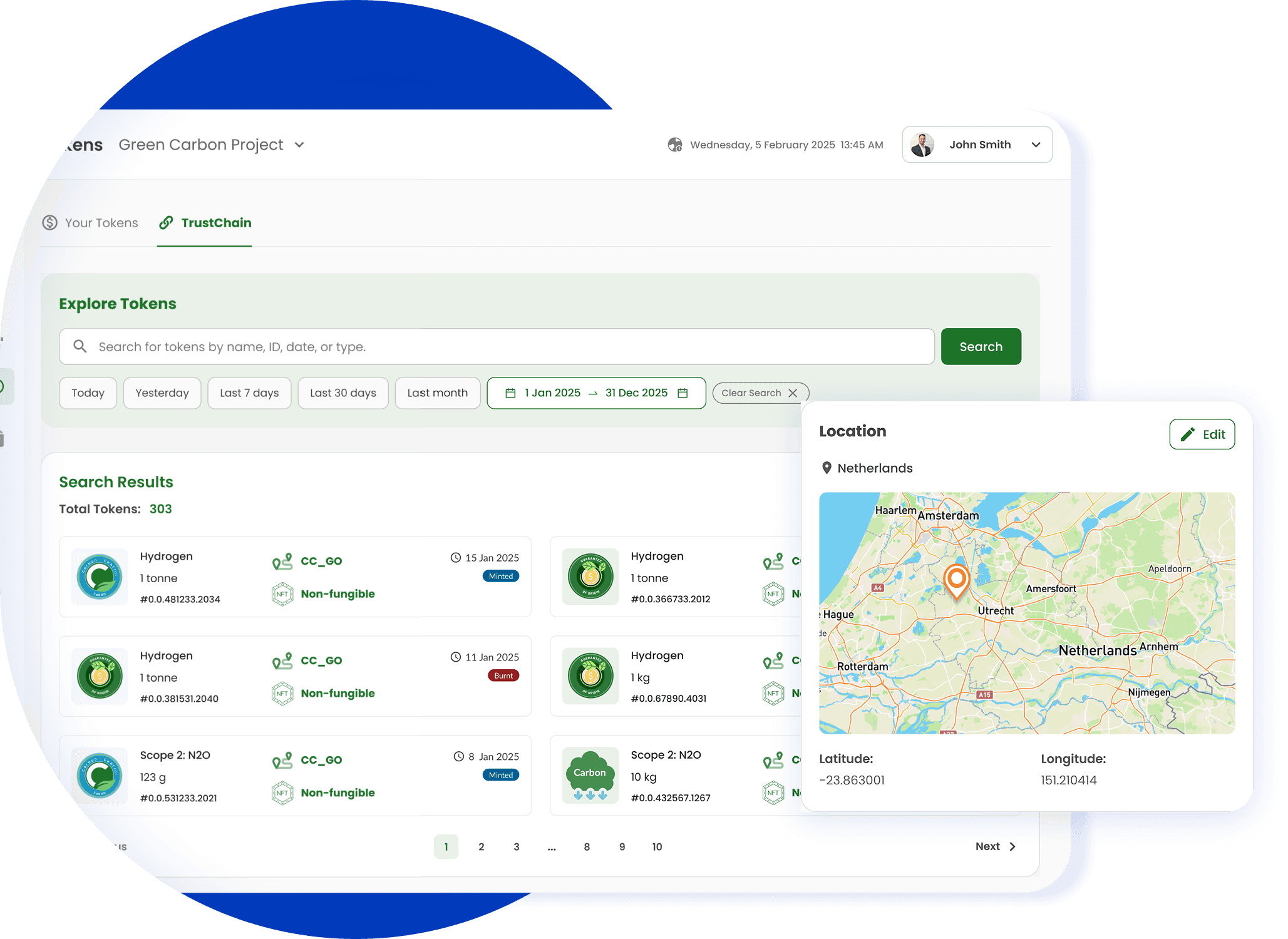
For fuel traders and emerging SAF certificate markets, this creates a digital layer that sits alongside the physical fuel supply chain. Sustainability attributes linked to SAF production can be allocated separately from the fuel itself through verified certificates or book-and-claim systems, provided the underlying feedstock data, lifecycle emissions calculations, and certification records remain auditable across organisations.

CORSIA and SAF Accounting: How Emissions Claims Are Verified
The environmental value of sustainable aviation fuel is determined by how its lifecycle emissions are documented and verified. Certification schemes such as ISCC and RSB assess feedstock sustainability, production pathways, and lifecycle emissions reductions associated with SAF batches.
Airlines operating under the Carbon Offsetting and Reduction Scheme for International Aviation (CORSIA) can use certified SAF lifecycle emissions reductions to lower their offsetting obligations.
In practice, this means that lifecycle emissions reductions linked to SAF must remain documented and auditable across production, blending, and use.
This requirement places growing importance on consistent chain-of-custody records. Producers, fuel suppliers, airlines, and regulators all rely on these records to confirm that emissions reductions attributed to SAF correspond to verified production and certification data.
Japan's early focus on certification frameworks and tracking infrastructure reflects a broader principle emerging across SAF markets: reliable sustainability data must accompany the fuel throughout its lifecycle.
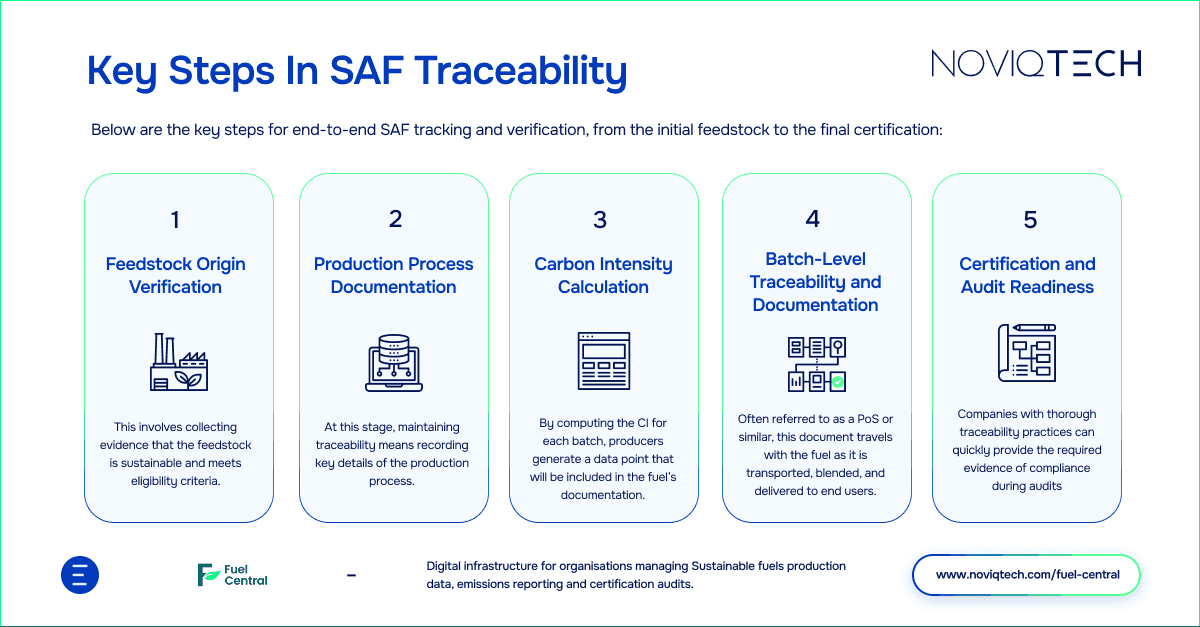
Figure 1: Key Steps in SAF Traceability
What Japan’s SAF Strategy Signals for Producers and Fuel Traders
Japan’s SAF strategy highlights an emerging market reality. Demand targets create momentum, but participation in these markets depends on the ability to demonstrate verified sustainability data across complex supply chains.
For producers and fuel traders, this means maintaining verifiable documentation linking feedstock sourcing, production pathways, lifecycle emissions calculations, and certification status. These records must remain accessible long after the fuel itself has been consumed and ownership has transferred across the supply chain.
As SAF trade expands internationally, the credibility of emissions claims will depend on the quality and continuity of the data supporting them.
Building traceability systems for SAF supply chains
Organisations producing, trading, or certifying SAF increasingly need systems capable of maintaining chain-of-custody records, lifecycle emissions data, and certification information across multiple partners.
Fuel Central provides infrastructure designed for these requirements. Teams can track SAF production batches, maintain mass balance positions across supply chains, and manage book-and-claim allocations while preserving verifiable sustainability data as fuel moves between producers, traders, distributors, and airlines.
If your team is evaluating how to structure sustainability data for SAF production, trading or fuel distribution, reach out for a strategy call.
Frequently Asked Questions About SAF in Japan
What is Japan’s SAF target for 2030?
Japan aims to replace around 10 percent of conventional aviation fuel with Sustainable Aviation Fuel (SAF) by 2030.
Government estimates suggest this will require approximately 1.7 million kilolitres of SAF annually to supply domestic and international flights departing from Japanese airports.
This target forms part of Japan’s broader strategy to reduce aviation emissions while supporting the country’s net zero commitment for 2050.
Will Japan produce SAF domestically or rely on imports?
Japan is developing domestic SAF production, but imported fuels and feedstocks are expected to play a significant role.
The country has limited biomass resources and a low level of energy self-sufficiency, which means large-scale SAF production will likely depend on international supply chains. Early projects already involve SAF imports for blending and testing within Japan’s aviation fuel infrastructure.
How does book and claim work for aviation fuel?
Book and claim is an accounting method that separates the physical delivery of SAF from the environmental benefits associated with the fuel.
Under this system, an airline can purchase SAF and claim the associated emissions reduction even if the fuel is used at a different airport or by another airline. The emissions benefit is transferred through verified records rather than through the physical movement of the fuel itself.
This approach helps scale SAF adoption when production sites, blending facilities, and airports are located in different regions.
What Is Sustainable Aviation Fuel (SAF)?
Sustainable Aviation Fuel, commonly referred to as SAF, is a category of aviation fuels produced from non-fossil sources that can reduce lifecycle greenhouse gas emissions compared with conventional jet fuel.
Unlike experimental propulsion technologies, SAF is designed as a drop-in fuel. This means it can be blended with conventional jet fuel and used in existing aircraft engines and airport fuelling infrastructure without requiring major modifications.
Most SAF pathways approved today fall into several main categories:
Hydroprocessed Esters and Fatty Acids (HEFA)
Produced from used cooking oil, animal fats, and waste oils. HEFA currently represents the majority of global SAF production.
Alcohol-to-Jet (ATJ)
Produced by converting alcohols such as ethanol into jet fuel molecules through catalytic processes.
Fischer–Tropsch (FT) fuels
Produced from biomass, agricultural residues, or municipal waste through gasification and synthetic fuel synthesis.
Power-to-Liquid (PtL) or e-SAF
Produced from captured carbon dioxide and renewable hydrogen using electrochemical processes.
These pathways differ in feedstocks and production technologies, but they share a common objective: producing jet fuel that meets strict aviation specifications while lowering lifecycle emissions.
Lifecycle reductions typically range from 50% to more than 80% compared with fossil jet fuel, depending on the feedstock and production process.
Because SAF is chemically similar to conventional jet fuel, international aviation standards allow airlines to blend it with traditional fuel. Current certification rules permit blends of up to 50 percent for most pathways.
This compatibility explains why SAF has become the central decarbonisation strategy for aviation. Aircraft fleets remain in service for decades, and fully replacing them with hydrogen or electric propulsion will take many years. Drop-in fuels allow emissions reductions to begin immediately within the existing aviation system.
Why SAF Is Central to Aviation Decarbonisation?
Aviation faces structural constraints that make decarbonisation particularly difficult.
Jet fuel contains far more energy per kilogram than batteries, which limits the feasibility of electric propulsion for long-distance flights. Hydrogen offers promise for some aircraft designs, but large-scale adoption requires new aircraft platforms, new airport infrastructure, and extensive regulatory approvals.
As a result, many aviation strategies focus on SAF as the primary near- and medium-term pathway to reduce emissions.
Industry bodies such as the International Air Transport Association estimate that SAF could deliver more than half of aviation’s emissions reductions by 2050 if production scales globally.
However, expanding SAF use requires solving several structural challenges:
• limited feedstock availability
• complex international supply chains
• certification requirements
• reliable tracking of emissions reductions
These challenges explain why many governments, including Japan, have moved beyond general climate commitments to develop detailed SAF strategies that address supply, accounting, and verification.
More Circular Economy