4 mins read

WEF 2026 Global Aviation Sustainability Outlook – The Missing Infrastructure Layer Behind Aviation's Climate Commitments
The WEF's Global Aviation Sustainability Outlook 2026 carries a theme that deserves more attention from fuel executives than it typically gets: "pragmatism over perfection." The report makes clear that to deliver net-zero, aviation will need to commercialise sustainable aviation fuels, transform airports into economic, digital and energy hubs, and expand market mechanisms such as book-and-claim.
What receives less coverage is the enabling layer that ties all three together: digital infrastructure and traceability. And right now, that infrastructure is dangerously underdeveloped.
The Real Bottleneck: Supply and Credibility
SAF remains the primary lever for decarbonisation, yet it is currently projected to cover less than 1% of total fuel consumption. Supply is hindered by high production costs, two to five times higher than kerosene, and competition for raw feedstocks.
By 2025, global SAF production reached 1.9 million tons, doubling from 2024 and accounting for 0.6% of total aviation fuel consumption.
The production challenge is real and urgent. But running alongside it, and often receiving far less attention, is an accountability problem: even when SAF exists, the systems to credibly track and trade it often do not. Paper certificates, disconnected spreadsheets, and manual reconciliation processes are still commonplace. At the volumes the industry needs to reach, that approach fails.
Three Gaps Digital Infrastructure Must Close
The WEF Global Aviation Sustainability Outlook 2026 points to three systemic challenges where digital tools are the practical answer:
1. Supply Chain Traceability
SAF might touch a feedstock grower, refiner, blender, shipper, and airport fuel depot before it reaches a wing, often across multiple countries. Without end-to-end digital tracking, verifying that it delivers its promised carbon reduction is like navigating without a flight plan: error-prone and risky.
What's needed: A digital chain-of-custody system, essentially a passport for each fuel batch, that records its origin, carbon intensity, blend, and ownership at every transfer point.
2. Book-and-Claim at Scale
Book-and-claim allows airlines to purchase SAF's environmental attributes separately from physical fuel delivery, enabling SAF to be produced where it is most economically viable and claimed anywhere in the world. Scaling this mechanism is central to the Outlook's recommendations. But it introduces a specific and serious risk: without rigorous certificate management, the same environmental attribute can be sold to two different buyers simultaneously. That is a structural weakness in any system that relies on manual processes or disconnected records. When it happens, the emissions reduction reported by one buyer is the same reduction reported by another, and neither claim holds up.
What's needed: Blockchain-backed certificates that are issued, transferred, and retired on a single platform, with an immutable audit trail any counterparty can verify.
3. Regulatory Fragmentation
Differences in goals, timelines, and sustainability standards across countries increase the complexity of cross-border operations. A SAF producer selling into the EU, complying with ICAO CORSIA, and aligning with RSB certification is effectively running three parallel reporting processes from the same underlying data.
What's needed: A single data layer that feeds multiple regulatory frameworks – collect once, report everywhere.

How NoviqTech's Platforms Address Each Gap
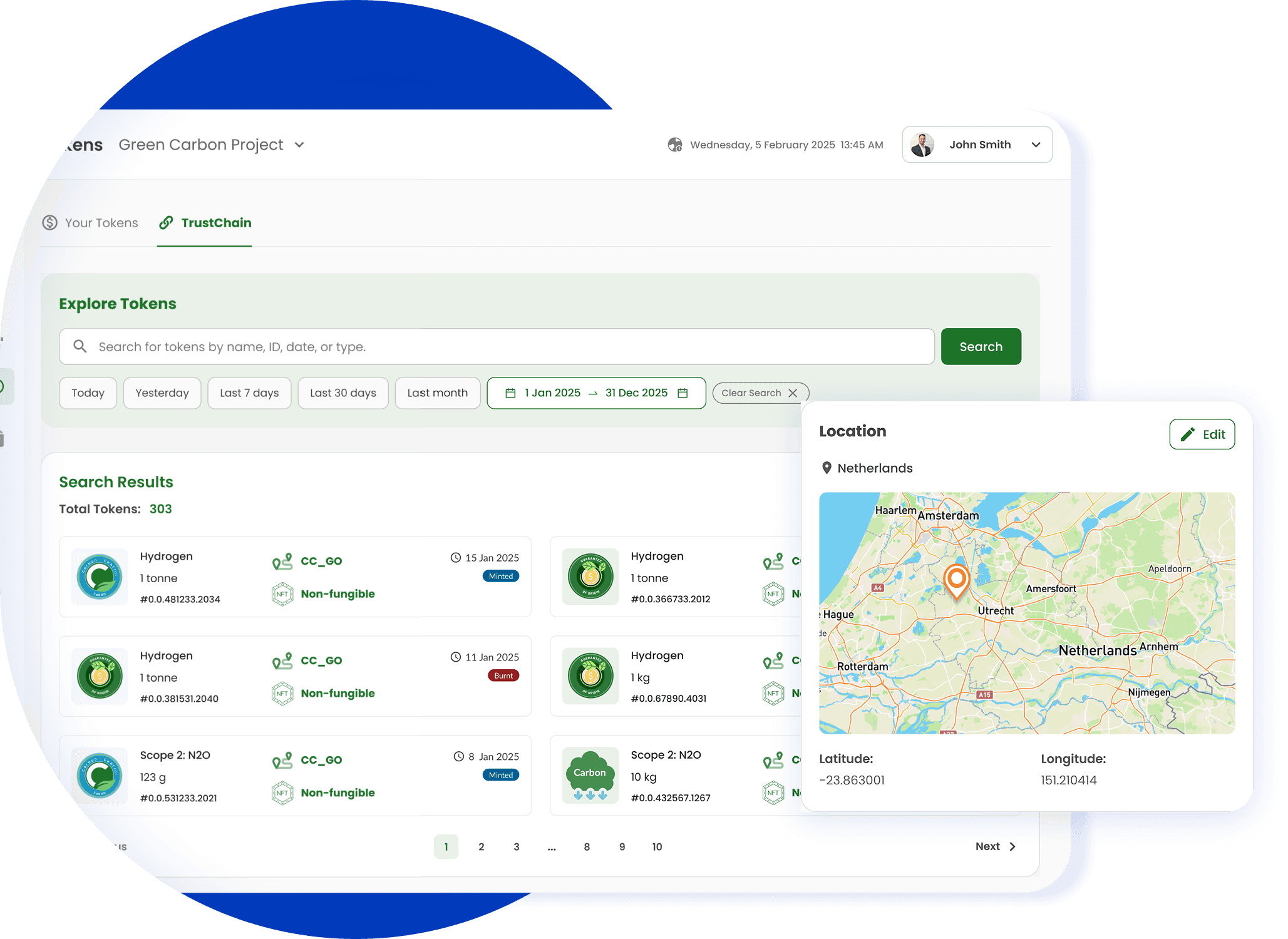
NoviqTech's Carbon Central and Fuel Central platforms were built specifically for these problems. Here's how they map to the WEF's identified challenges:
Challenge Highlighted (WEF 2026) | Traditional Approach | Digital Solution (NoviqTech) |
Scaling SAF with transparency | Paper certificates, siloed spreadsheets to track SAF batches and credits. Risk of human error or fraud in tracking origin and carbon data. | Carbon Central uses digital twin integration to consolidate and track sustainability attributes from feedstock sourcing through production output. Batch management functionality ensures accurate data segregation and mass balance accounting, so no data is lost or misattributed. |
Global SAF trading (Book-and-Claim) | Manual certificate trading with lengthy reconciliation. Difficult for airlines to verify origin of purchased credits. | Fuel Central tokenises each unit of fuel as a blockchain-backed credit with full audit oversight. It supports book-and-claim offtakes, including export to external registries, and generates eligible documents such as Proof of Sustainability and Sustainability Declarations aligned to relevant schemes. |
Diverse regulatory requirements | Multiple audits and reports for various schemes (e.g. separate reporting for EU, ICAO, etc.), each with different data formats. | Fuel Central is designed for interoperability, supporting both national frameworks such as Guarantee of Origin and international schemes such as RSB and ISCC. A single verified dataset can align to any requested framework without duplicating the underlying data collection. |
Accountability & Greenwashing risk | Trust-based claims, spotty verification. Data stored in PDFs or disconnected systems, making audits labour-intensive and slow. | Carbon Central captures emissions intensity and environmental attributes per batch within one integrated system. Every claim is linked back to traceable source data, enabling generation of audit-ready compliance documents at the batch level. |
When Carbon Central and Fuel Central operate together, production-side data and post-production tracking connect into a single verified record. The result is a shared source of truth across a supply chain that may span multiple continents, producers, blenders, and buyers. When all parties work from the same dataset, due diligence that previously took months can close in days.
Three Priorities for SAF Executives in 2026
Taking the Outlook's findings at face value, here is where attention should go:
Pair physical infrastructure with digital infrastructure. A new SAF production facility or blending operation without a robust tracking system means verified sustainability claims cannot be made at scale. These two investments belong together.
Don't wait for regulatory clarity to build traceability. The frameworks (CORSIA, EU RED III, ReFuelEU) are already in motion. Companies that build data systems now will convert compliance from a cost into a competitive advantage.
Make transparency a partnership tool. In a supply chain with many players, trust is currency. Sharing verified sustainability dashboards with partners and buyers, without exposing sensitive trade data, accelerates deal-making. Due diligence that used to take months can close in days when counterparties operate from a shared, verified dataset. '
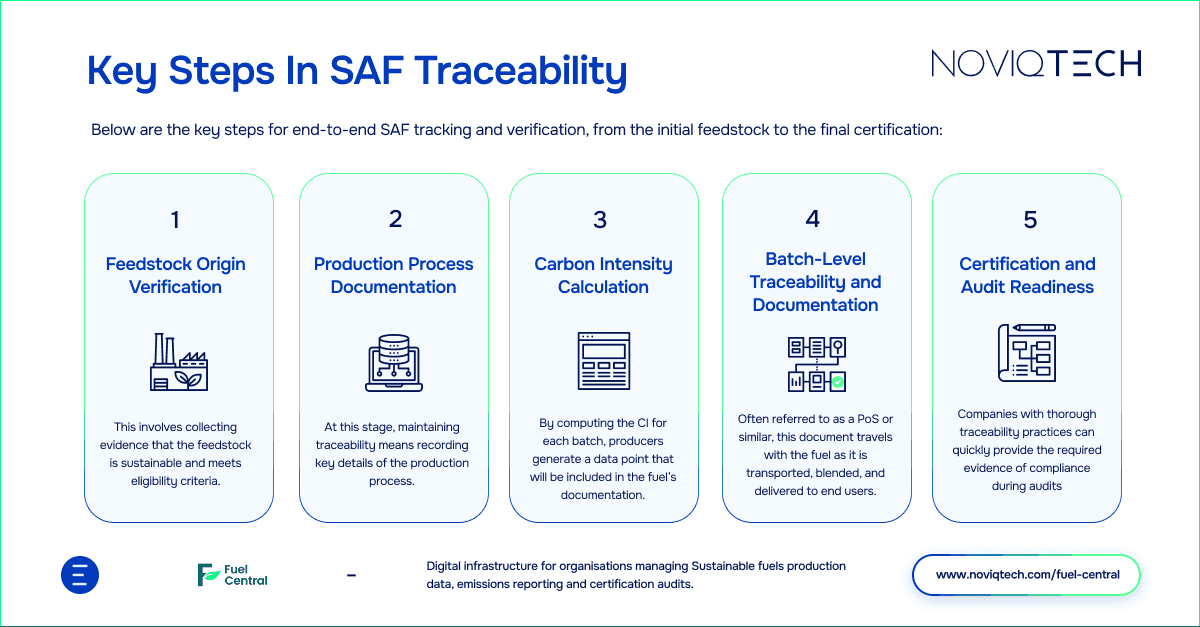
Figure 1: Key Steps in SAF Traceability
SAF Traceability and Reporting: Why Digital Infrastructure Can't Wait
The Outlook underscores a shift toward pragmatic, coordinated action across industry, government, and finance to translate long-term climate ambition into achievable, near-term outcomes.
For the SAF sector, that pragmatism starts with acknowledging that sustainable fuel alone is not enough. The infrastructure to track it, trade it credibly, and report on it across frameworks has to exist at the same scale. That infrastructure layer is available now. The question for executives is whether they build it before they need it, or after the first audit finds gaps.
NoviqTech's Carbon Central and Fuel Central platforms provide end-to-end digital infrastructure for SAF producers, traders, and distributors. Contact us for a discovery call.
The WEF Global Aviation Sustainability Outlook 2026 is available in full at weforum.org. The full report PDF is also accessible directly here.
More Supply Chains